Harvest Moon is the farming game that started the series now known as Story of Seasons. Developed by Amccus and published by Pack-In-Video, it came out in Japan on 9 August 1996 as Bokujō Monogatari. Director and producer Yasuhiro Wada wanted a country-life game at a time when fighting games dominated, and drew on his childhood in Miyazaki on Kyushu; Alpine dairy farms, the manga Dr. Slump and the Derby Stallion horse-breeding games were also influences.
The game took three years to make with a team of 8 to 10 people. When the parent company went bankrupt, only Wada, programmer Tomomi Yamatate and designer Setsuko Miyakoshi stayed on for the final six months.
Natsume brought the game to North America in 1997, and Nintendo released it in Europe on 29 January 1998 with German and French language options. Japan also got a four-episode Satellaview spin-off, BS Bokujō Monogatari, in September 1996.1
Names and releases
| Region | Title on the box | Platform | Date | Publisher | Src |
|---|---|---|---|---|---|
| NA | Harvest MoonSources disagree on the day: the infobox gives 17 June 1997, the article body 17 August 1997 | SNES | 1997 | Natsume | 1 |
| JP | 牧場物語Bokujō Monogatari | SNES | Aug 9, 1996 | Pack-In-Video | 1 |
| EU | Harvest MoonWith German and French language options | SNES | Jan 29, 1998 | Nintendo | 1 |
| JP | 牧場物語Nintendo Switch Online Super Famicom library (Japan) | Switch | 2022 | Nintendo | 1 |
Also known as: 牧場物語 JP1Bokujō Monogatari JP1
Box art by region
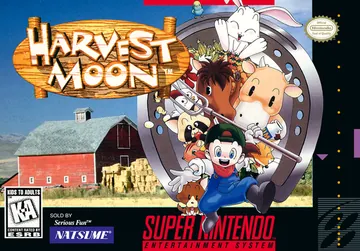
NA Harvest Moon 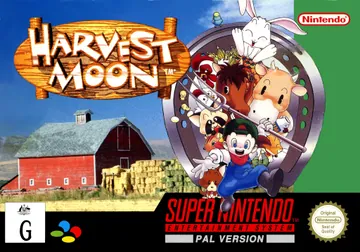
EU Harvest Moon
Box art © its publishers, shown to identify each release. Scans: libretro-thumbnails.
Version differences
-
TextSNES (NA/EU)
The English localization calls alcohol "juice", even though characters who drink it still get drunk.1
-
TextSNES (NA/EU)
Some Japanese details survived localization: townspeople speak of a "God of the Harvest" and a "God of Business" in Shinto terms, an onigiri appears in the new-day scenes, and the news anchor bows to viewers.1
-
TextSNES (EU)
The European release, published by Nintendo, added German and French language options.1
Translations
Reception
Sales started slowly, at about 20,000 copies in Japan, but positive reviews and word of mouth later pushed them past 100,000. Famitsu scored the game 7, 9, 9 and 9, GameRankings shows an average of 73%, and IGN later ranked it 46th in its Top 100 SNES Games.1
Sources
Checked: 2026-10-13Text reviewed: 2026-10-13
Spotted a mistake? Write to atlas@old-games.net.