The Super NES version of SimCity is Nintendo's own take on Maxis's city builder. Developed by Nintendo EAD and Intelligent Systems and published by Nintendo under license from Maxis, it came out in Japan on 26 April 1991, in North America on 23 August 1991 and in Europe on 24 September 1992.
Nintendo gave the game a personality the computer versions lacked. Dr. Wright, an adviser modeled on SimCity creator Will Wright, pops up to report problems; Bowser replaces the monster disaster; and a city that grows to 500,000 residents earns a Mario statue. The soundtrack was composed by Soyo Oka.
The cartridge sold 1.98 million units worldwide, 900,000 of them in Japan. In August 1996 a version called BS SimCity Machizukuri Taikai was broadcast to Japanese players over the Satellaview. The game was also sold on the Wii Virtual Console, but it was no longer available there as of 2 January 2013.1
Names and releases
| Region | Title on the box | Platform | Date | Publisher | Src |
|---|---|---|---|---|---|
| NA | SimCity | SNES | Aug 23, 1991 | Nintendo | 1 |
| JP | SimCity | SNES | Apr 26, 1991 | Nintendo | 1 |
| EU | SimCity | SNES | Sep 24, 1992 | Nintendo | 1 |
| JP | BS SimCity Machizukuri TaikaiSatellaview broadcast version | SNES | August 1996 | Nintendo | 1 |
Also known as: BS SimCity Machizukuri Taikai JP1
Box art by region
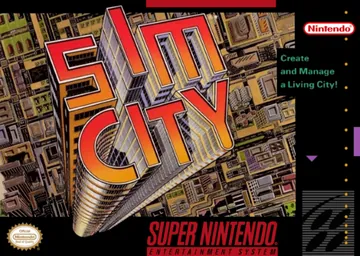
NA SimCity 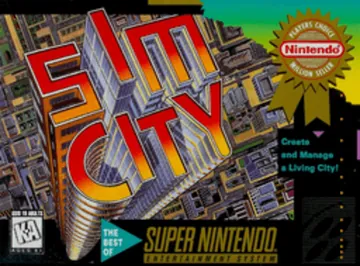
EU SimCity 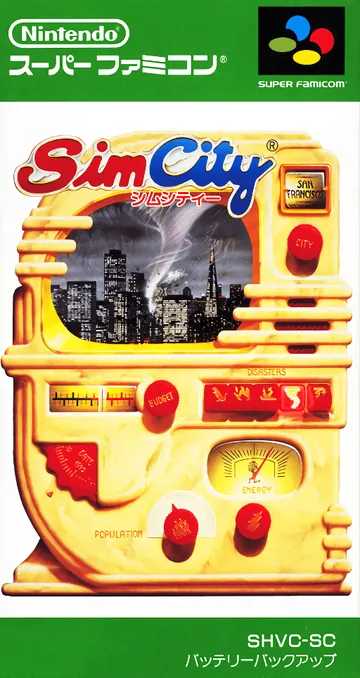
JP SimCity
Box art © its publishers, shown to identify each release. Scans: libretro-thumbnails.
Version differences
-
ContentSNES
Only the SNES version has Dr. Wright, a green-haired adviser modeled on Will Wright who appears to report the city's problems.1
-
ContentSNES
Bowser replaces the monster disaster of the computer versions, and a city of 500,000 residents is rewarded with a Mario statue.1
-
GameplaySNES
As the city grows, reward buildings such as casinos, amusement parks and expo centers become available; a bank lends $10,000; and schools and hospitals can't be placed by hand, since the game converts empty residential lots into them.1
Reception
The SNES version sold 1.98 million units worldwide, including 900,000 in Japan, and became part of Nintendo's Player's Choice line as a million-seller. Famitsu scored it 9, 8, 9 and 7, Mean Machines gave it 94%, and IGN ranked it 35th in its Top 100 SNES Games of All Time.1
Sources
Checked: 2026-10-13Text reviewed: 2026-10-13
Spotted a mistake? Write to atlas@old-games.net.