Technōs Japan released Double Dragon III on the Famicom on 22 February 1991, and Acclaim published it in North America the same month as Double Dragon III: The Sacred Stones. PAL regions got it on 24 November 1994. The game is loosely based on the 1990 arcade game Double Dragon 3: The Rosetta Stone, but it is not a port: the two were developed in parallel.
Billy and Jimmy Lee are joined by Chin Seimei after Mission 2 and the ninja Yagyu Ranzou after Mission 3, and each fighter carries a limited-use backup weapon. The NES game brings back separate punch and kick buttons, adds a dash and keeps the hair grab. Two players can fight together with friendly fire switched off or on.
The launch was a mixed success: it was the seventh best-selling console game in the US in February 1991, yet Acclaim was left with half a million unsold units.12
Names and releases
| Region | Title on the box | Platform | Date | Publisher | Src |
|---|---|---|---|---|---|
| NA | Double Dragon III: The Sacred Stones | NES | February 1991 | Acclaim Entertainment | 1 |
| JP | ダブルドラゴンIII ザ・ロゼッタストーンFamicom | NES | Feb 22, 1991 | Technōs Japan | 1 |
| EU | Double Dragon III: The Sacred StonesPAL release | NES | Nov 24, 1994 | Acclaim Entertainment | 1 |
| JP | ダブルドラゴンIII ザ・ロゼッタストーンProject EGG re-release of the Famicom version | Windows | Jul 6, 2010 | — | 2 |
Also known as: ダブルドラゴンIII ザ・ロゼッタストーン JP1Double Dragon III: The Rosetta Stone JP1双截龍III JP2
Box art by region
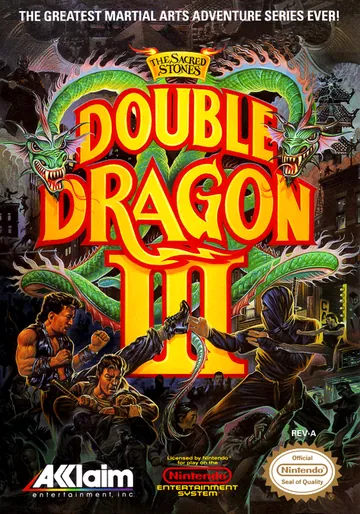
NA Double Dragon III: The Sacred Stones 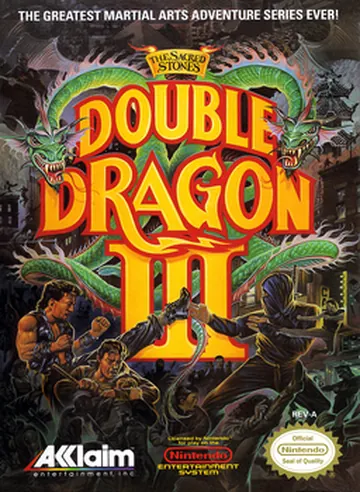
EU Double Dragon III: The Sacred Stones
Box art © its publishers, shown to identify each release. Scans: libretro-thumbnails.
Version differences
-
TextFamicom (JP)NES (NA/EU)
The English version adds a mission to rescue Marion. The Japanese script never mentions her, and the Lee brothers hunt for the stones to become the world's strongest fighters.1
-
TextFamicom (JP)NES (NA/EU)
In Japan the murdered friend Brett is called Aldo, and his killer is Jim, brother of Willy from the first Double Dragon; this subplot was cut from the English version.1
-
DifficultyFamicom (JP)
The Japanese version is easier: characters get more health per stage and there are fewer enemies.1
Translations
-
English Official
Acclaim Entertainment1991NES · Japanese Famicom versionReleased · complete
Official English NES release by Acclaim, with a rewritten story.1
Reception
Famitsu's reviewers gave it 4, 7, 6 and 4 out of 10. In the US it was the seventh best-selling console game of February 1991 according to the Software Publishers Association, but Electronic Gaming Monthly reported that Acclaim had overestimated demand and was left with half a million unsold cartridges.1
In lists
Sources
Checked: 2026-10-13Text reviewed: 2026-10-13
Spotted a mistake? Write to atlas@old-games.net.