Dig Dug is an arcade game that Namco released in Japan in 1982; Atari, Inc. brought it to North America in April. It was designed by Masahisa Ikegami with help from Galaga creator Shigeru Yokoyama, and Hiroshi "Mr. Dotman" Ono drew the sprites. Namco sold it as a "strategic digging game": the hero tunnels through the earth and defeats Pookas and fire-breathing Fygars by pumping them up or dropping rocks on them.
It was the first video game project of composer Yuriko Keino. A realistic footstep sound was not feasible, so she wrote a short melody that plays only while the hero moves. The hero later got the name Taizo Hori, a pun on the Japanese "horitai zo" ("I want to dig"), and in the Mr. Driller series he became the father of Susumu Hori.
The game set off a wave of digging games, including Mr. Do! (1982). The Famicom version followed in Japan on 4 June 1985.12
Names and releases
| Region | Title on the box | Platform | Date | Publisher | Src |
|---|---|---|---|---|---|
| NA | Dig Dug | Arcade | April 1982 | Atari, Inc. | 1 |
| NA | Dig DugAtari 2600 and Atari 5200 | Other | October 1983 | Atari, Inc. | 1 |
| NA | Dig DugIBM PC; Atari 8-bit, Commodore 64 and Apple II versions the same month | MS-DOS | December 1984 | — | 1 |
| NA | Dig DugAtari 7800 | Other | May 15, 1986 | Atari Corporation | 1 |
| NA | Dig DugAdds a New Dig Dug mode; also released in Europe in 1992 | Game Boy | September 1992 | — | 1 |
| EU | Dig Dug | Arcade | Apr 19, 1982 | Namco | 1 |
| JP | ディグダグDigudaguSources conflict: English Wikipedia gives 20 February 1982 (also a US copyright record date), Japanese Wikipedia gives March 1982 | Arcade | 1982 | Namco | 2 |
| JP | ディグダグNamcot Game Center series | MSX | 1984 | Namco | 2 |
| JP | ディグダグDigudaguFamicom | NES | Jun 4, 1985 | Namco | 2 |
| JP | ディグダグFamicom Disk System, based on the Famicom version | Famicom Disk System | Jul 20, 1990 | Namco | 1 |
| JP | ディグダグDeveloped by Dempa, bundled with Dig Dug II | X68000 | Feb 24, 1995 | — | 1 |
| JP | ディグダグFamicom Mini (Famicom version); English Wikipedia gives 21 June 2004 | Game Boy Advance | May 21, 2004 | Nintendo | 2 |
| WW | Dig DugXbox Live Arcade, with online leaderboards and achievements | Xbox 360 | 2006 | Namco | 1 |
| JP | ディグダグVirtual Console; English Wikipedia gives 2009 (Japan only), Japanese Wikipedia lists Famicom-version Virtual Console dates in 2008 | Wii | 2008 | Namco | 1 |
| WW | ARCADE GAME SERIES: DIG DUGArcade version; also on PS4 and Xbox One | Windows | Apr 19, 2016 | Bandai Namco Entertainment | 3 |
| WW | Arcade Archives DIG DUGArcade Archives on PS4 and Switch; Japanese Wikipedia gives 4 August 2022. Uses the later arcade revision | Switch | 2022 | Hamster | 1 |
Also known as: ディグダグ JP2Digudagu JP2ARCADE GAME SERIES: DIG DUG WW3
Box art by region
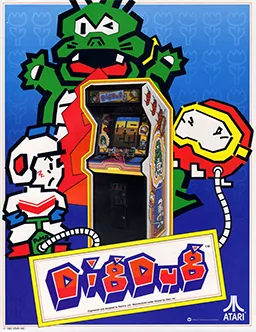
EU Dig Dug
Box art © its publishers, shown to identify each release. Scans: Wikipedia.
Version differences
-
Bug fixArcade (early boards)Arcade (later revision)
Early arcade boards had bugs: a round could fail to end after certain rock kills, Fygar stopped moving from round 126, and Pooka froze in its eyes-only form from round 136. A later revision fixed several of these, and Arcade Archives uses that revision.2
-
Bug fixArcadelater Atari release
The arcade game has 255 rounds; on round 256 an 8-bit overflow spawns a Pooka that kills the player at once. A later Atari release patched this so play can continue indefinitely.1
-
GameplayFamicom
In the Famicom version, touching a Pooka while it drifts through the dirt as a pair of eyes no longer costs a life.2
Where to play legally today
-
Steam Purchase
Reception
Dig Dug was Japan's second highest-grossing arcade game of 1982, behind Namco's own Pole Position. In North America Atari sold 22,228 cabinets by the end of 1982 for $46,300,000. The 2004 Famicom Mini edition sold 58,572 copies, and the Xbox Live Arcade version 222,240 copies by 2011.1
Sources
Checked: 2026-10-13Text reviewed: 2026-10-13
Spotted a mistake? Write to atlas@old-games.net.