Galaxian is a shooting game that Namco released in Japanese arcades in 1979, with Midway handling North America. It was planned as Namco's answer to Space Invaders: designer Kazunori Sawano drew on Star Wars, and the enemies were first shaped like TIE fighters.
The game was technically ahead of its time. It was one of the first games with RGB color graphics and the first to use tile-based hardware that supported multicolor animated sprites and a scrolling background. It became Namco's first major arcade hit and its first arcade game with music composed on a synthesizer, and its hardware influenced Nintendo's Radar Scope, Donkey Kong and the Famicom.
The Famicom version, released on 7 September 1984, was the first Famicom title under Namco's Namcot label, and the Galaxian flagship turns up as the sixth fruit in Pac-Man. The world record of 2,010,000 points was set by David Lyne in 2016.12
Names and releases
| Region | Title on the box | Platform | Date | Publisher | Src |
|---|---|---|---|---|---|
| NA | GalaxianEnglish Wikipedia: shown at a trade exhibit in November 1979, wide release February 1980; TCRF gives December 1979 | Arcade | 1980 | Midway | 1 |
| NA | GalaxianBally Astrocade; later renamed Galactic Invasion | Other | August 1981 | Bally | 1 |
| NA | GalaxianAtari 5200; Atari 8-bit computer version also 1982 | Other | November 1982 | Atari, Inc. | 1 |
| NA | GalaxianAtari 2600 | Other | May 1983 | Atari, Inc. | 1 |
| NA | GalaxianIBM PC; Atarisoft also released Commodore 64 (July 1984), ColecoVision, VIC-20 and Apple II versions in 1984 | MS-DOS | 1983 | Atarisoft | 1 |
| JP | ギャラクシアンGyarakushianSources conflict: English Wikipedia gives 15 September 1979, Japanese Wikipedia and TCRF give October 1979 | Arcade | 1979 | Namco | 2 |
| EU | GalaxianEnglish Wikipedia gives November 1979, TCRF gives 1980; ENV distributed it in Germany | Arcade | 1979 | Namco | 1 |
| JP | ギャラクシアンPC-88 (NEC PC-8801) | Other | 1983 | — | 1 |
| JP | ギャラクシアンGyarakushianFamicom; Namcot's first Famicom title | NES | Sep 7, 1984 | Namco | 1 |
| JP | ギャラクシアンReleased in Europe and Japan only | MSX | 1984 | Namco | 1 |
| EU | GalaxianUK release | ZX Spectrum | 1984 | Atarisoft | 1 |
| JP | ギャラクシアンGyarakushianFamicom Disk System | Famicom Disk System | Jul 20, 1990 | Namco | 1 |
| JP | ギャラガ&ギャラクシアンCompilation with Galaga; NA September 1995 as Arcade Classic 3 (Nintendo), EU 1995 | Game Boy | Jul 14, 1995 | Namco | 1 |
| WW | Microsoft Return of ArcadeCompilation | Windows | 1995 | Microsoft | 1 |
| JP | アーケードアーカイブス ギャラクシアンArcade Archives; date from a reference heading on Japanese Wikipedia | Switch | Nov 24, 2022 | Hamster | 2 |
Also known as: ギャラクシアン JP2Gyarakushian JP2Galactic Invasion NA1Arcade Classic 3: Galaga / Galaxian NA1ギャラガ&ギャラクシアン JP2
Box art by region
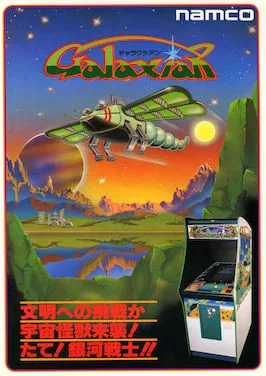
JP ギャラクシアン
Box art © its publishers, shown to identify each release. Scans: Wikipedia.
Version differences
-
TitleArcade (Taito)Arcade (Namco, older set)
Taito produced an alternate Japanese release that differs from the older Namco board only in the title-screen logo.3
-
DifficultyArcade (older sets)Arcade (newer sets)
Older boards let operators choose 3 or 5 starting lives and a bonus ship at 4,000, 5,000 or 7,000 points; newer boards allow only 2 or 3 lives and raise the bonus thresholds to 7,000, 10,000, 12,000 or 20,000 points.3
-
DifficultyArcade (Midway set 2)
One Midway US board uses lower bonus-life thresholds of 3,000, 4,000 or 5,000 points.3
Reception
In Japan Galaxian was the second highest-grossing arcade game of both 1979 (behind Space Invaders) and 1980 (behind Pac-Man); in the US it was second for 1980 behind Asteroids. About 40,000 arcade units were sold in the US by 1981 and 50,000 by 1982. In 2021 The Guardian called it the greatest video game of the 1970s.1
In lists
Sources
Checked: 2026-10-13Text reviewed: 2026-10-13
Spotted a mistake? Write to atlas@old-games.net.