Xevious is a vertically scrolling shooter that Namco released in Japanese arcades in 1983, with Atari, Inc. handling North America. Masanobu Endō led the design, Hiroshi "Mr. Dotman" Ono drew the graphics and Yuriko Keino wrote the music. The player's ship carries two weapons, a zapper for flying enemies and a blaster for ground targets, and bombing certain spots reveals hidden Sol Citadels.
The game is credited as one of the first with a boss fight, pre-rendered graphics and a storyline, and it is often called the father of vertically scrolling shooters. Japanese Wikipedia describes it as the first video game with hidden characters. Its music became Video Game Music (1984), produced by Haruomi Hosono and credited as the first video game soundtrack album.
The Famicom version arrived on 8 November 1984 and sold over 1.26 million copies in Japan. In March 2023 that NES version joined the Nintendo Classics library on Nintendo Switch Online.123
Names and releases
| Region | Title on the box | Platform | Date | Publisher | Src |
|---|---|---|---|---|---|
| NA | XeviousAtari held exclusive manufacturing and sales rights outside Japan; English Wikipedia infobox gives February 1983 | Arcade | 1983 | Atari, Inc. | 1 |
| NA | XeviousEnglish Wikipedia gives September 1988 | NES | Sep 8, 1988 | Bandai | 4 |
| NA | Classic NES Series: XeviousEnglish Wikipedia gives 7 June 2004, Japanese Wikipedia gives 2 June 2004 for the overseas release | Game Boy Advance | June 2004 | Nintendo | 1 |
| JP | ゼビウスZebiusuEnglish Wikipedia gives January 1983 in the text and February 1983 in the infobox; Japanese Wikipedia says the game was announced in January 1983 | Arcade | 1983 | Namco | 2 |
| JP | ゼビウスZebiusuSharp X1; the first home port | Other | May 25, 1984 | Namco | 2 |
| JP | ゼビウスZebiusuFamicom | NES | Nov 8, 1984 | Namco | 2 |
| EU | Xevious | Amstrad CPC | 1986 | U.S. Gold | 1 |
| EU | XeviousUK release | ZX Spectrum | February 1987 | U.S. Gold | 1 |
| EU | Xevious | NES | Oct 25, 1989 | Bandai | 4 |
| JP | ゼビウスZebiusuFamicom Disk System re-release | Famicom Disk System | May 18, 1990 | Namco | 4 |
| JP | ファミコンミニ ゼビウスFamikon Mini ZebiusuFamicom Mini line; the Famicom version | Game Boy Advance | Feb 14, 2004 | Nintendo | 2 |
| JP | ゼビウスZebiusuVirtual Console, Famicom version | Wii | Dec 2, 2006 | Namco Bandai Games | 2 |
| JP | ゼビウスZebiusuVirtual Console Arcade, arcade version | Wii | Sep 1, 2009 | Namco Bandai Games | 2 |
| JP | ゼビウスZebiusuVirtual Console | Wii U | Apr 27, 2013 | Namco Bandai Games | 2 |
| WW | Arcade Archives XEVIOUSArcade version; also released on PS4 | Switch | 2021 | Hamster | 1 |
| WW | XeviousNES version added to the Nintendo Classics (Nintendo Switch Online) NES library | Switch | Mar 15, 2023 | Nintendo | 3 |
Also known as: ゼビウス JP2Zebiusu JP2Cheyenne WW1Zevious WW1ファミコンミニ ゼビウス JP2Arcade Archives XEVIOUS WW5
Box art by region
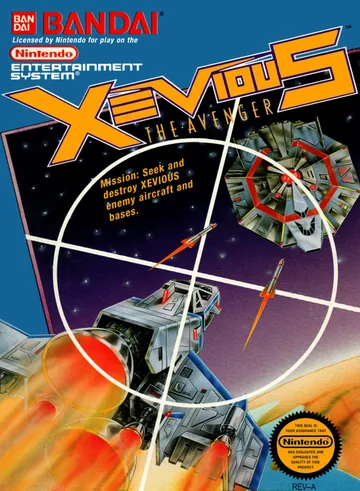
EU Xevious 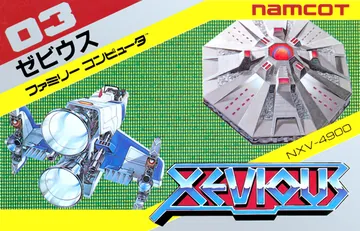
JP ゼビウス
Box art © its publishers, shown to identify each release. Scans: libretro-thumbnails.
Version differences
-
GraphicsFamicom
On the Famicom the title logo is drawn as a blocky mosaic of 8×8-pixel tiles.2
-
ContentFamicom
The Nazca line drawings on the ground were cut from the Famicom version because there was not enough memory.2
-
GameplayFamicom
The wider Famicom screen means slower scrolling and a relatively faster Solvalou ship, and no more than four Bacura plates can appear at once.2
Where to play legally today
-
Nintendo Switch Online Subscription
-
Arcade Archives Purchase
Arcade Archives XEVIOUS (Nintendo Switch)
Arcade version (Japanese ROM)
Checked: 2026-10-135nintendo.com
Reception
The arcade game broke sales records at launch in Japan and topped Game Machine's table-cabinet chart in November 1983; in North America Atari sold 5,295 cabinets by the end of 1983. The Famicom version sold over 1.26 million copies in Japan, and the NES version 1.5 million cartridges worldwide.1
In lists
Sources
Checked: 2026-10-13Text reviewed: 2026-10-13
Spotted a mistake? Write to atlas@old-games.net.