Soul Blazer is an action RPG developed by Quintet and published by Enix for the Super Famicom in Japan on January 31, 1992, as Soul Blader. Masaya Hashimoto directed and programmed it, Yasuyuki Sone produced it, Tomoyoshi Miyazaki wrote the story and Yukihide Takekawa composed the music.
The game reached North America on November 27, 1992, and Europe on January 27, 1994, with English, German and French versions; the United Kingdom never got it. The Western release reworked menus for English text, changed the title logo, altered several boss rooms and turned a bare-chested female boss into a male figure.
Fans see Soul Blazer as the first part of an unofficial trilogy that continues with Illusion of Gaia (1993) and Terranigma (1995). Quintet reported 295,000 copies sold worldwide, and the game has never been re-released in any form.12
Names and releases
| Region | Title on the box | Platform | Date | Publisher | Src |
|---|---|---|---|---|---|
| NA | Soul Blazer | SNES | Nov 27, 1992 | Enix | 1 |
| JP | ソウルブレイダー | SNES | Jan 31, 1992 | Enix | 3 |
| EU | Soul BlazerPAL release with English, German and French versions; not released in the United Kingdom | SNES | Jan 27, 1994 | Enix | 1 |
Also known as: ソウルブレイダー JP3Soul Blader JP1
Box art by region
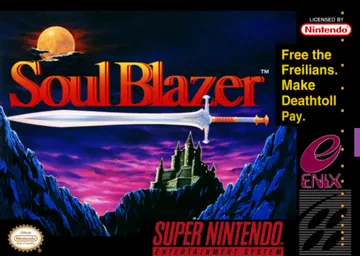
NA Soul Blazer 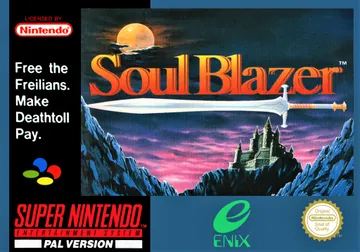
EU Soul Blazer
Box art © its publishers, shown to identify each release. Scans: libretro-thumbnails.
Version differences
-
CensorshipSNES (NA)SNES (EU)
The fourth boss is a bare-chested female figure in Japan; the Western versions turned it into a male figure.4
-
GameplaySNES (NA)SNES (EU)
Some boss rooms changed: Solid Arm's conveyor belts run the other way and the middle bridge became a conveyor, and in the West you can stand safely between Deathtoll's flames.4
-
TextSNES (NA)SNES (EU)
Menus were reworked for English: file names went from five to eight characters, and the status screen was split, with collected souls moved to their own page.4
Translations
-
English Official
Enix1992SNES · Japanese versionReleased · complete
English version released in North America in 1992; the English PAL version shows 1993 on its copyright screen.4
-
German Official
Enix1994SNESReleased · complete
German PAL version.4
-
French Official
Enix1994SNESReleased · complete
French PAL version.4
Reception
Quintet reported 295,000 copies sold: 200,000 in Japan, 70,000 in North America and 25,000 in Europe. Famitsu scored it 32/40 (Gold Hall of Fame), it holds an 85.58% GameRankings average, and Electronic Gaming Monthly gave it an Editor's Choice Gold award.1
In lists
Sources
Checked: 2026-10-13Text reviewed: 2026-10-13
Spotted a mistake? Write to atlas@old-games.net.