Lunar Pool is a billiards game developed by Compile. It first came out in Japan as Lunar Ball for the PC-88 in June 1985, followed by MSX and Famicom versions in December of that year. FCI brought the NES version to North America in October 1987 and to Europe in 1991.
The game mixes pool with elements of miniature golf: balls must be sunk into pockets on oddly shaped tables, some of them with obstacles. Table friction can be set anywhere from 0 to 255, with 32 as the default, which simulates different gravity and explains the lunar theme. The Famicom/NES version has 60 levels, and the game ends when all lives are lost or every level is cleared. Sega's SG-1000 game Champion Billiards plays almost the same way, but on conventional tables and with 50 stages.
The game also turns up on screen: characters play it on the NES in the Mexican telenovela María la del Barrio. Its code hides the string 'JEMINI DAZO!!', a nod to programmer Takayuki Hirono.123
Names and releases
| Region | Title on the box | Platform | Date | Publisher | Src |
|---|---|---|---|---|---|
| NA | Lunar Pool | NES | October 1987 | FCI | 2 |
| NA | Lunar PoolVirtual Console; North America only | Wii | Oct 22, 2007 | — | 2 |
| JP | Lunar BallPC-88 (NEC PC-8801); 20 stages | Other | June 1985 | Pony Canyon | 1 |
| JP | ルナーボールRunā BōruFamicom; 60 stages | NES | Dec 5, 1985 | Pony Canyon | 2 |
| JP | Lunar Ball32 stages | MSX | December 1985 | Pony Canyon | 1 |
| EU | Lunar Pool | NES | 1991 | FCI | 2 |
Also known as: Lunar Ball JP3ルナーボール JP1Runā Bōru JP2Бильярд на Луне RU4
Box art by region
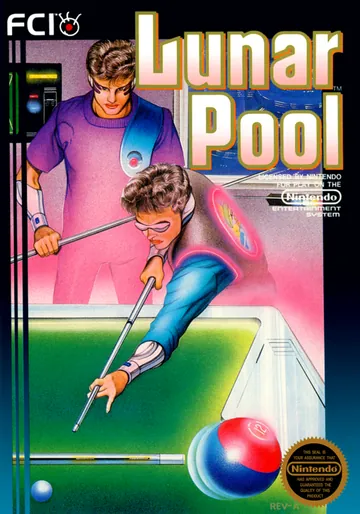
NA Lunar Pool 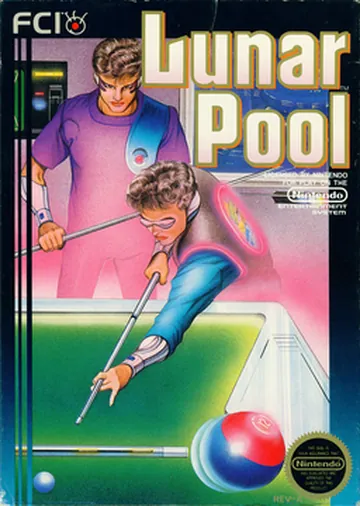
EU Lunar Pool
Box art © its publishers, shown to identify each release. Scans: libretro-thumbnails.
Version differences
-
ContentPC-88MSXFamicom/NES
Each new version added stages: 20 on PC-88, 32 on MSX and 60 on Famicom/NES.1
-
GameplayMSXFamicom/NES
The MSX and Famicom versions let players pick the starting stage; the PC-88 original does not.1
-
TitleNES (NA/EU)
The international title screen removes the Japanese staff credits and Pony Canyon logo to fit longer copyright text, and adds a trademark symbol.3
Reception
Readers of Famicom Magazine rated the Famicom version 15.82 out of 30, and a 1991 guide described it as a game for enthusiasts.1
In lists
Sources
Checked: 2026-10-13Text reviewed: 2026-10-13
Spotted a mistake? Write to atlas@old-games.net.