Little Samson is an action platformer developed by Takeru and published by Taito. It came out on the Famicom in Japan on 26 June 1992 as Seirei Densetsu Lickle, then in North America in November 1992 and in Europe in March 1993. Its director, producer and writer, Shinichi Yoshimoto, had worked on Ghouls 'n Ghosts and Strider at Capcom.
The player can switch at any time between four heroes: the boy Samson, the dragon Kikira, the golem Gamm and the mouse K.O. Each has different moves, which matters across the game's 20 stages; the first four work as tutorials and can be played in any order.
Poor marketing kept North American sales low, and Little Samson became one of the rarest and most expensive NES games. In 2025 Limited Run Games announced a re-release for Nintendo Switch, PlayStation 5 and PC via Steam, planned for 2026.1
Names and releases
| Region | Title on the box | Platform | Date | Publisher | Src |
|---|---|---|---|---|---|
| NA | Little Samson | NES | November 1992 | Taito | 1 |
| JP | 聖鈴伝説リックルSeirei Densetsu RikkuruFamicom | NES | Jun 26, 1992 | Taito | 2 |
| EU | Little SamsonWikipedia gives 13 March 1993, TCRF 18 March 1993 | NES | March 1993 | Taito | 1 |
Also known as: 聖鈴伝説リックル JP2Seirei Densetsu Rikkuru JP1Seirei Densetsu Lickle JP1
Box art by region
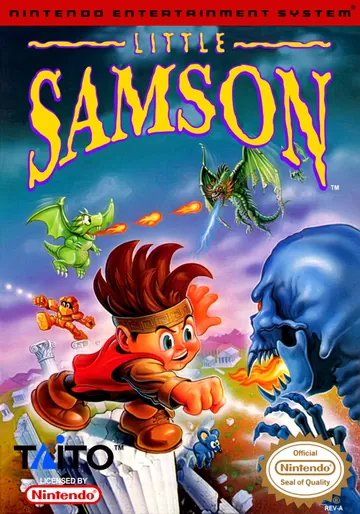
NA Little Samson 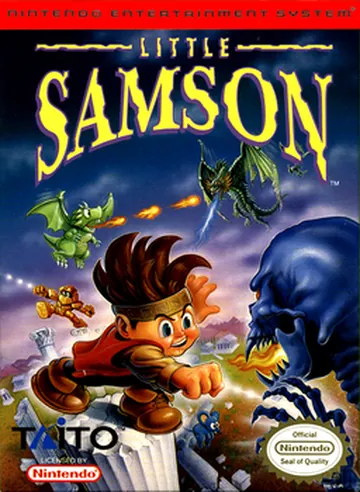
EU Little Samson
Box art © its publishers, shown to identify each release. Scans: libretro-thumbnails.
Version differences
-
ContentNES (NA/EU)
The Japanese version jumps straight into the intro cutscene when switched on; the international versions briefly show the title screen first.3
-
TextNES (NA/EU)
The international versions use a different password font, with the letters reordered, the vowels dropped from the end and '?' and '&' added, so the same passwords show different characters.3
-
CensorshipNES (NA/EU)
A small amount of cleavage was removed from the river boss in the international version.3
Translations
-
English Official
Taito1992NES · Japanese Famicom versionReleased · complete
Taito published the English-language NES version in North America in 1992 and in Europe in 1993.1
Reception
Famitsu's four reviewers gave it 6, 5, 7 and 5 out of 10, praising the audiovisuals, and Western magazines were moderate (Game Players 5/10, HobbyConsolas 72/100). Retrospective reviews are warmer: AllGame gave it 4.5/5, and IGN, USgamer and Paste have listed it among the best NES games.1
In lists
Sources
Checked: 2026-10-13Text reviewed: 2026-10-13
Spotted a mistake? Write to atlas@old-games.net.