Faxanadu is an action RPG developed by Hudson Soft and released on the Famicom in Japan on 16 November 1987. It is a spin-off of Xanadu, the second game in Falcom's Dragon Slayer series, and its name is a portmanteau of Famicom and Xanadu. Development began as a Famicom port of Xanadu, but the project became an original game, and the title changed because the Xanadu trademark could not be obtained.
Nintendo published the game in North America in August 1989 and in Europe in 1990. The hero climbs the World Tree to save the elven town of Eolis, saving progress with passwords called mantras. Jun Chikuma composed the music.
The game was re-released on the Wii Virtual Console in 2010 and 2011.12
Names and releases
| Region | Title on the box | Platform | Date | Publisher | Src |
|---|---|---|---|---|---|
| NA | Faxanadu | NES | August 1989 | Nintendo | 2 |
| JP | ファザナドゥFazanaduFamicom | NES | Nov 16, 1987 | Hudson Soft | 1 |
| EU | FaxanaduDate marked as needing a citation on English Wikipedia | NES | Dec 28, 1990 | Nintendo | 2 |
| EU | FaxanaduVirtual Console; released in 2010 and 2011 across regions; Japanese Wikipedia lists 5 October 2010 for PAL regions | Wii | 2010 | — | 2 |
Also known as: ファザナドゥ JP1ザナドゥ(仮) JP1
Box art by region
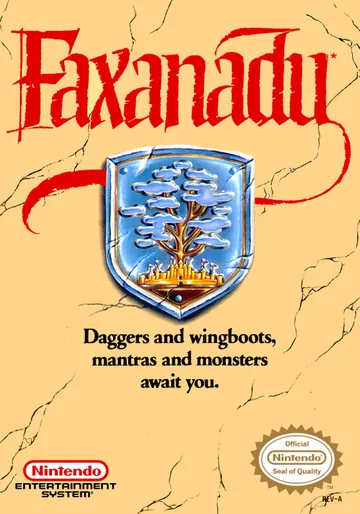
NA Faxanadu 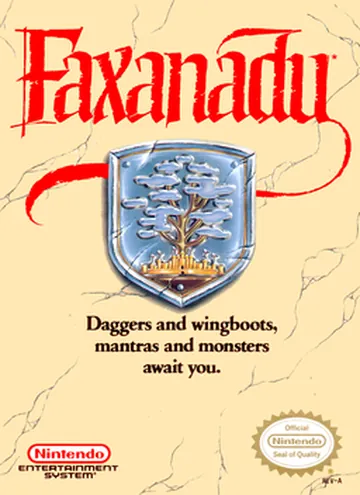
EU Faxanadu 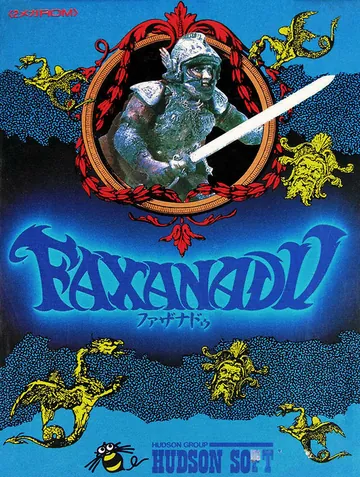
JP ファザナドゥ
Box art © its publishers, shown to identify each release. Scans: libretro-thumbnails.
Version differences
-
GameplayFamicom (JP)
Only the Japanese version lets the player name the hero (up to four characters); the name appears throughout the script and affects passwords. Everywhere else he is called Nello.3
-
CensorshipNES (NA/EU)
The international versions removed crosses from the churches and the crucifix and rosary from church interiors, renamed the priests gurus and redrew their portrait.3
-
TextNES (NA/EU)
The Western releases replaced the large Japanese 16x16 font with smaller 8x8 fonts, and the passwords, called prayers in Japan, became mantras.3
Translations
-
English Official
Nintendo1989NES · Japanese Famicom versionReleased · complete
Nintendo published the English-language NES version in North America in 1989 and in Europe in 1990.2
Reception
Famitsu gave it 29 out of 40. The Virtual Console release drew strong reviews: IGN gave 8.5/10 and called it a hidden gem, and Nintendo Life gave 8/10. Retro Gamer ranked it 16th among the best NES games.2
In lists
Sources
Checked: 2026-10-13Text reviewed: 2026-10-13
Spotted a mistake? Write to atlas@old-games.net.