The Little Mermaid was developed and published by Capcom in 1991 for the NES and Game Boy, based on Disney's 1989 animated film. The Famicom version came out in Japan on 19 July 1991, with the North American NES release the same month. Tokuro Fujiwara produced it; Yasuaki Fujita composed the NES music and Hitoshi Sakimoto the Game Boy music.
Ariel fights by trapping enemies in bubbles and throwing them. She also digs in the sand for treasure and uses shells to open chests holding power-ups. The adventure spans six stages, from the Coral Sea to two battles at Ursula's castle.
The two versions look and sound noticeably different, from stage intros to music. The Game Boy version had a second life in North America in 1997, when it was re-released under Nintendo's Player's Choice label.1
Names and releases
| Region | Title on the box | Platform | Date | Publisher | Src |
|---|---|---|---|---|---|
| NA | The Little Mermaid | NES | July 1991 | Capcom | 1 |
| NA | The Little MermaidPlayer's Choice re-release | Game Boy | 1997 | Nintendo | 1 |
| JP | リトル・マーメイド —人魚姫—Ritoru Māmeido: Ningyo Hime | NES | Jul 19, 1991 | CapcomCAP-3U | 2 |
| None | The Little Mermaid | Game Boy | 1991 | Capcom | 1 |
Also known as: リトル・マーメイド —人魚姫— JP2Ritoru Māmeido: Ningyo Hime JP2Русалочка RU3
Box art by region
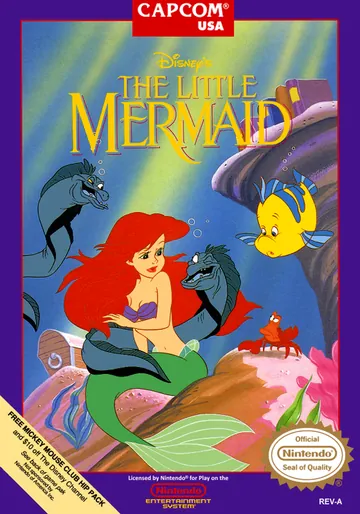
NA The Little Mermaid 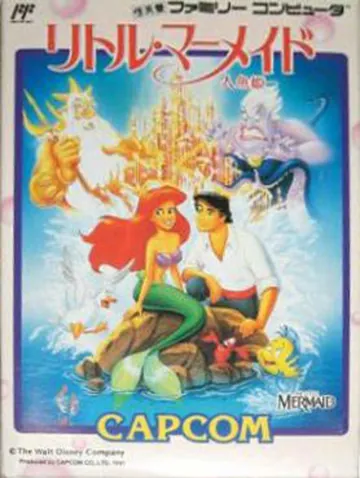
JP リトル・マーメイド —人魚姫—
Box art © its publishers, shown to identify each release. Scans: libretro-thumbnails.
Version differences
-
GameplayNESGame Boy
On the NES Ariel swims down from the top of the screen to the starting point of each stage, while on the Game Boy she simply starts there.1
-
AudioNESGame Boy
On the NES only the opening part of each stage theme plays, once, while the Game Boy can loop the full track; the boss music is also in a different key and much faster on the NES.1
-
GraphicsGame Boy
The Game Boy backgrounds are simpler, and a lost heart vanishes completely instead of leaving an empty heart outline as on the NES.1
Reception
By December 1991 the game had sold 500,000 copies and was described as a big hit with female players, who made up most of its audience. Electronic Gaming Monthly gave it 27/40.1
Sources
- 1en.wikipedia.org
- 2ja.wikipedia.org
- 3overclockers.ru
- 4ja.wikipedia.org
- 5ja.wikipedia.org
- 6ja.wikipedia.org
Checked: 2026-10-13Text reviewed: 2026-10-13
Spotted a mistake? Write to atlas@old-games.net.