F-1 Race was developed by HAL Laboratory under Satoru Iwata and published by Nintendo for the Famicom in Japan on 2 November 1984. Japanese Wikipedia describes it as the first car racing game on the Famicom. Iwata said it was also the first Famicom game with raster scrolling: the hardware did not support the effect natively, so it was programmed from scratch.
Each course has to be finished in two laps within a time limit, using a two-speed LOW/HI gearbox, and crashing into other cars or roadside objects destroys the car. The game never came out on the NES in North America or Europe.
Nintendo R&D1 later made a reworked Game Boy version, released in Japan on 9 November 1990 and in the West in 1991. The Famicom game led to two Japan-only sequels, Famicom Grand Prix: F1 Race and Famicom Grand Prix II: 3D Hot Rally, and Iwata's love of racing games influenced later Nintendo series such as F-Zero and Mario Kart.123
Names and releases
| Region | Title on the box | Platform | Date | Publisher | Src |
|---|---|---|---|---|---|
| NA | F-1 Race | Game Boy | Feb 3, 1991 | Nintendo | 1 |
| JP | F1レースFamicom; never released on the NES in North America or Europe | NES | Nov 2, 1984 | Nintendo | 2 |
| JP | F1レースReworked Game Boy version developed by Nintendo R&D1 | Game Boy | Nov 9, 1990 | Nintendo | 2 |
| EU | F-1 Race | Game Boy | Oct 10, 1991 | Nintendo | 1 |
Also known as: F1レース JP2F★1レース JP2F1 Race JP3
Box art by region
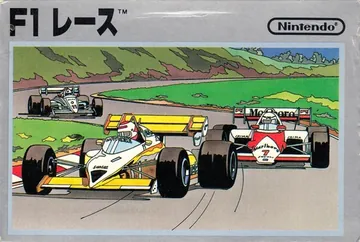
JP F1レース
Box art © its publishers, shown to identify each release. Scans: libretro-thumbnails.
Version differences
-
GameplayGame Boy
The Game Boy version has longer tracks set in different countries and new modes; a speed boost replaces the gear shift, and hitting other cars no longer destroys your car.1
-
GameplayGame Boy
The Game Boy version supports up to four players with the Four Player Adapter, which Japanese Wikipedia calls a first for the Game Boy.2
-
ContentGame Boy
Nintendo characters such as Mario, Link, Samus and Donkey Kong appear at the end of tracks in the Game Boy version.1
Reception
Famitsu's cross review gave the Famicom game 24 out of 40, and Family Computer Magazine readers rated it 21.11 out of 30; the magazine called it fast but monotonous. GamesRadar later ranked the Game Boy version 49th among the best Game Boy and Game Boy Color games.2
Sources
Checked: 2026-10-13Text reviewed: 2026-10-13
Spotted a mistake? Write to atlas@old-games.net.